
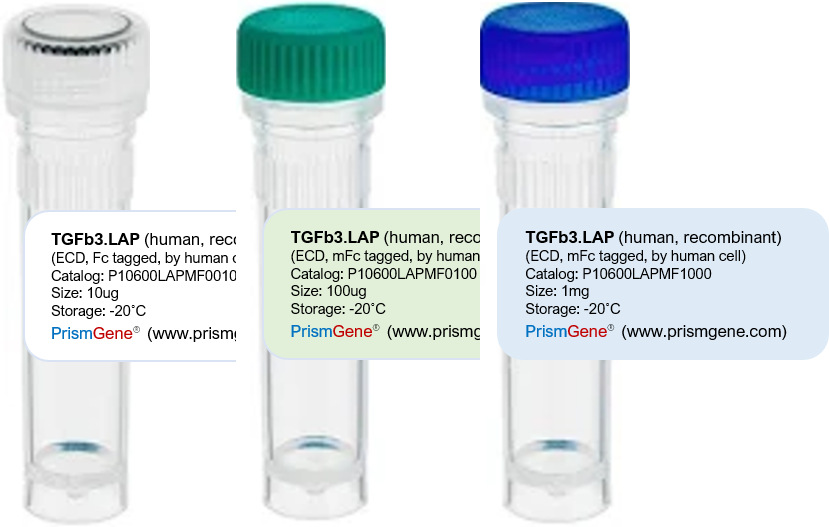
TGFb3.LAP
Price range: $295.00 through $695.00
Protein Full Name: Latency-associated peptide (LAP) of transforming growth factor beta-3
Alternative Names: Pro-domain of TGFb3, TGFb3.LAP, Transforming growth factor beta-3 proprotein, Latency-associated peptide, LAP.
Uniprot ID: P10600
Amino Acids: aa24-300, plus C-terminal mouse Fc
Fusion Tag: C-terminal, mouse mFc
Source: Recombinant, expressed in human cell, HEK293
Predicted Molecular Weight (WM): 58kDa
SDS-PAGE: 32kDa, reducing condition
Purity: >95%, by SDS-PAGE with Coomassie® Blue Staining.
Endotoxin Level: <1.0 EU/μg of protein.
Activity: Active
Transforming growth factor beta (TGF-β) is a multifunctional cytokine belonging to the transforming growth factor superfamily that includes three different mammalian isoforms (TGF-β 1, 2, 3), BMPs (bone morphogenetic proteins), GDFs (growth and differentiation factors), inhibins and activins. TGFB proteins are produced by all white blood cell lineages.
All three TGF-βs are synthesized as precursor molecules containing a propeptide region in addition to the TGF-β homodimer. After it is synthesized, the TGF-β homodimer interacts with a Latency Associated Peptide (LAP), a protein derived from the N-terminal region of the TGF-β gene product, forming a complex called Small Latent Complex (SLC). This complex remains in the cell until it is bound by another protein called Latent TGF-β-Binding Protein (LTBP), forming a larger complex called Large Latent Complex (LLC). It is this LLC that gets secreted to the extracellular matrix (ECM).
The peptide structures of the TGF-β isoforms are highly similar (homologies on the order of 70–80%). They are all encoded as large protein precursors; TGF-β1 contains 390 amino acids and TGF-β2 and TGF-β3 each contain 412 amino acids. They each have an N-terminal signal peptide of 20–30 amino acids that they require for secretion from a cell, a pro-region called latency associated peptide (LAP – Alias: Pro-TGF beta 1, LAP/TGF beta 1), and a 112-114 amino acid C-terminal region that becomes the mature TGF-β molecule following its release from the pro-region by proteolytic cleavage.
Transforming growth factor beta-3 proprotein is activated into the Latency-associated peptide (LAP) and mature transforming growth factor beta-3 (TGF-beta-3) chains, which constitute the regulatory and active subunit of TGF-beta-3, respectively. Latency-associated peptide is required to maintain the Transforming growth factor beta-3 (TGF-beta-3) chain in a latent state during storage in extracellular matrix. LAP associates non-covalently with TGF-beta-3 and regulates its activation via interaction with ‘milieu molecules’, such as LTBP1 and LRRC32/GARP.
The activation process involves in cell differentiation, embryogenesis and secondary palate development. TGF-β3 is believed to regulate molecules involved in cellular adhesion and extracellular matrix (ECM) formation during the process of palate development. Without TGF-β3, mammals develop a deformity known as a cleft palate. This is caused by failure of epithelial cells in both sides of the developing palate to fuse. TGF-β3 also plays an essential role in controlling the development of lungs in mammals, by also regulating cell adhesion and ECM formation in this tissue, and controls wound healing by regulating the movements of epidermal and dermal cells in injured skin.
| Size | 10ug, 50ug |
|---|
Be the first to review “TGFb3.LAP”
Related products






Reviews
There are no reviews yet.