
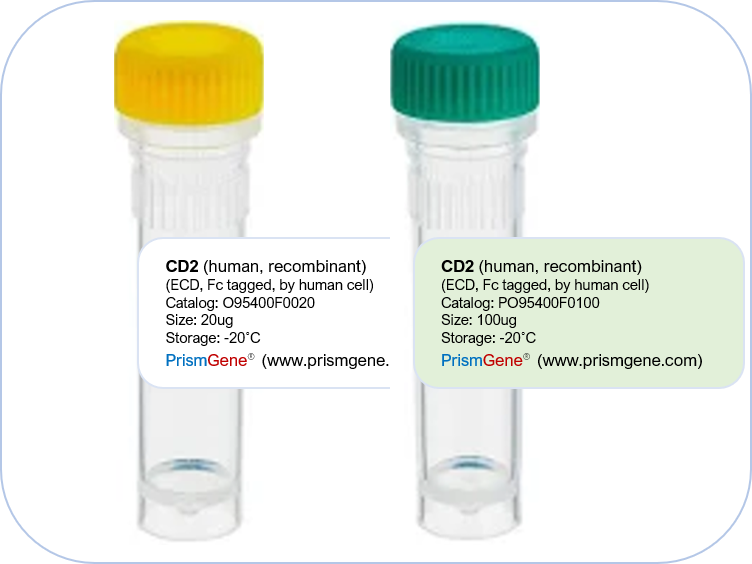
CD2
Price range: $395.00 through $895.00
Fusion Tag: C-terminal human Fc
Protein Full Name: CD2 antigen cytoplasmic tail-binding protein 2
Alternative Names: CD2BP2, U5-52K, CD2 cytoplasmic domain-binding protein 2, CD2 tail-binding protein 2
Uniprot ID: O95400
Amino Acids: aa 1-341, ECD plus C-terminal human Fc
Source: Recombinant, expressed in human cell, HEK293
Predicted Molecular Weight (WM): 63.6kDa
SDS-PAGE: 66kDa, reducing condition
Purity: >95%, by SDS-PAGE with Coomassie® Blue Staining.
Endotoxin Level: <1.0 EU/μg of protein.
Activity: Active
Datasheet (PDF): CD2
CD2 (Cluster of Differentiation 2) is a type I transmembrane glycoprotein and a member of the immunoglobulin superfamily. Its extracellular region consists of two immunoglobulin-like domains: an amino-terminal variable (V-set) domain that directly binds ligands, and a constant (C2-set) domain. The protein has a single transmembrane alpha-helix connected to a highly conserved, proline-rich intracellular tail containing SH3-binding motifs. It lacks intrinsic kinase activity but relies on this cytosolic tail to interact with adapter proteins and Src-family kinases.
CD2 acts primarily as a pan-T cell and natural killer (NK) cell marker that governs adhesion, co-stimulation, and signal transduction:
- Cell Adhesion: It facilitates critical trans-cellular binding between T/NK cells and target cells. In humans, its primary ligand is CD58 (LFA-3), which is ubiquitously expressed on antigen-presenting cells (APCs).
- Immunological Synapse Formation: The CD2-CD58 interaction stabilizes the contact zone between a T cell and an APC, physically organizing the immunological synapse.
- Co-stimulation: CD2 acts as a co-receptor by lowering the activation threshold of the T-cell receptor (TCR). Ligand binding induces intracellular signaling via kinases like Lck and Fyn, which induces cytokine production (such as IL-2 and IFN-γ, drives proliferation, and triggers NK cell cytotoxicity.
CD2 is expressed early in lymphoid development and widely utilized in immunohistochemistry as a definitive marker for T-cell and NK-cell lineages. It helps pathologists differentiate T-cell lymphomas and leukemias from B-cell neoplasms.
Modulating the CD2/CD58 pathway holds significant therapeutic value. Biologics and monoclonal antibodies (like siplizumab or alefacept) target CD2 to inhibit costimulation, safely treating autoimmune diseases like psoriasis or preventing transplant rejection. Conversely, engineering CAR T-cell therapies to amplify CD2 co-stimulatory pathways enhances anti-tumor persistence and cytolysis, countering tumor immune evasion caused by down-regulated CD58.
References:
- Genet. 36:40-45 (2004)
- Cell 127:635-648 (2006)
- Nat Struct Mol Biol 31:752-756 (2024)
| Size | 20ug, 100ug |
|---|
Be the first to review “CD2”
Related products

Reviews
There are no reviews yet.