
CD3D
Price range: $395.00 through $895.00
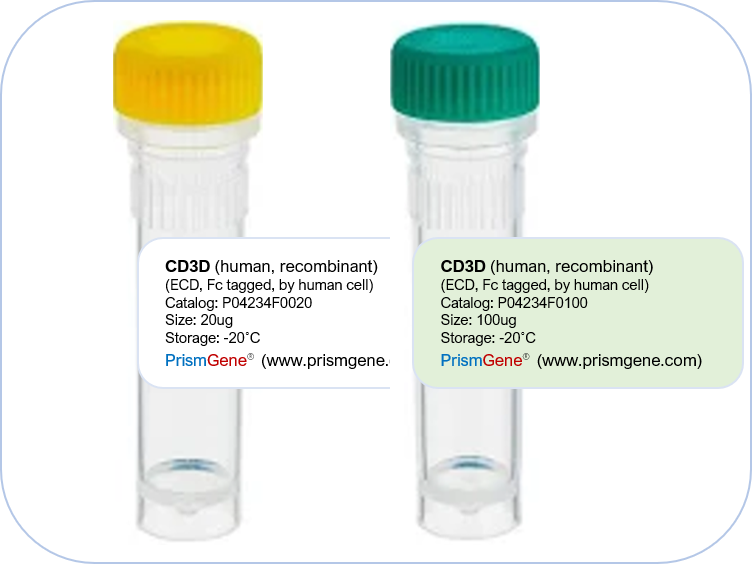
Fusion Tag: extracellular domain with C-terminal human Fc
Protein Full Name: T-cell surface glycoprotein CD3 delta chain
Alternative Names: T-cell receptor T3 delta chain
Uniprot ID: P04234
Amino Acids: aa 22-105, ECD plus C-terminal human Fc
Source: Recombinant, expressed in human cell, HEK293
Predicted Molecular Weight (WM): 35.5kDa
SDS-PAGE: 50kDa, reducing condition
Purity: >95%, by SDS-PAGE with Coomassie® Blue Staining.
Endotoxin Level: <1.0 EU/μg of protein.
Activity: Active
Datasheet: CD3D
CD3d (Cluster of Differentiation 3 delta) is a vital invariant transmembrane glycoprotein encoded by the CD3D gene. It plays a foundational role in the adaptive immune system by regulating the assembly, stability, and signaling of the T-cell receptor (TCR) complex.
CD3δ is a type I transmembrane glycoprotein belonging to the immunoglobulin superfamily. It comprises roughly 171 amino acids organized into three distinct domains:
- Extracellular Domain: An immunoglobulin-like ectodomain that non-covalently pairs with CD3ε to form a CD3δε heterodimer.
- Transmembrane Region: A highly conserved hydrophobic domain containing a negatively charged amino acid residue that interacts with the positively charged TCR α-chain, anchoring the complex.
- Cytoplasmic Tail: A region containing a single Immunoreceptor Tyrosine-based Activation Motif (ITAM).
CD3δ performs two primary physiological roles:
- TCR Assembly and Maturation: Within the endoplasmic reticulum, the CD3δε heterodimer serves as a critical chaperone, binding nascent TCRα chains. This process shields the chains from degradation and facilitates transport to the plasma membrane. Without it, mature αβ-TCR complexes cannot successfully express on the cell surface, halting thymocyte differentiation.
- Signal Transduction: Because TCR α/β chains lack signaling capabilities, CD3δ bridges antigen recognition to internal responses. Upon TCR engagement with a peptide-MHC molecule, tyrosine kinases (such as LCK and FYN) phosphorylate the cytoplasmic ITAM of CD3δ. This recruits ZAP-70, initiating downstream cascades that drive T-cell activation, cytokine production, and proliferation.
Biallelic loss-of-function mutations in the CD3D gene result in autosomal recessive SCID. This stops early T-cell development, creating a life-threatening T-cell-negative phenotype (T–B+NK+) requiring hematopoietic stem cell transplantation.
CD3δ expression is a robust marker for tumor-infiltrating T lymphocytes. Elevated expression levels correlate with favorable prognoses, early staging, and enhanced therapeutic responses to immune checkpoint inhibitors in various malignancies.
Bispecific antibodies and monoclonal antibodies targeting the CD3 complex are continuously leveraged to orchestrate targeted tumor cell lysis or to induce immunosuppression in severe autoimmune diseases
References:
- Nature 634:729-736 (2024)
- Cell 185:3201-3213.e19 (2022)
- Nature 573:546-552 (2019)
| Size | 20ug, 100ug |
|---|
Be the first to review “CD3D”
Related products
Reviews
There are no reviews yet.