
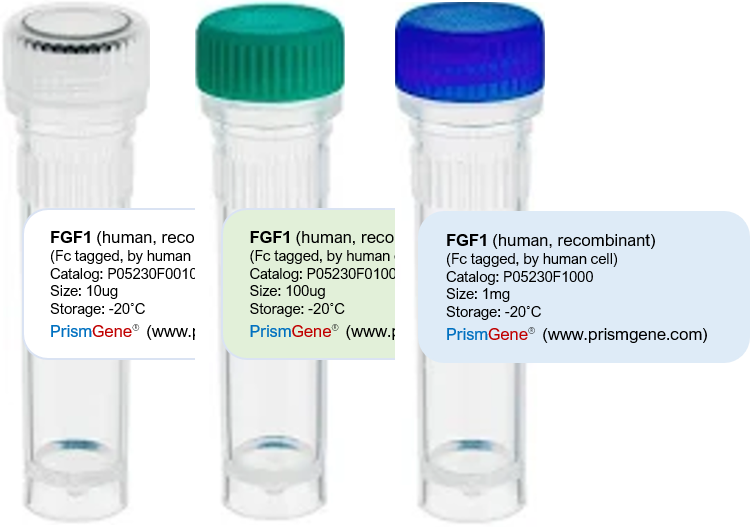
FGF1


Price range: $395.00 through $2,495.00
Fusion Tag: C-terminal human Fc
Protein Full Name: Human fibroblast growth factor 1
Alternative Names: Acidic fibroblast growth factor, aFGF, Endothelial cell growth factor, ECGF, Heparin-binding growth factor 1, HBGF-1, FGFA
Uniprot ID: P05230
Amino Acids: aa 16-155, plus C-terminal human Fc
Source: Recombinant, expressed in human cell, HEK293
Predicted Molecular Weight (WM): 41.8kDa
SDS-PAGE: kDa, reducing condition
Purity: >95%, by SDS-PAGE with Coomassie® Blue Staining.
Endotoxin Level: <1.0 EU/μg of protein.
Fibroblast growth factor 1 (FGF-1) also known as acidic fibroblast growth factor (aFGF), is a growth factor and signaling protein encoded by the FGF1 gene. FGF-1 has no definitive signal sequence to secrete through classical pathways, but it does appear to form a disulfide linked dimer inside cells associating with a complex of proteins at the cell membrane (including S100A13 and Syt1). The complex proteins help flip it through the membrane to the exterior of the cell. Once in the reducing conditions, the dimer dissociates into monomeric FGF1 that can enter systemic circulation or be sequestered in tissues binding to heparan sulfate proteoglycans of the extracellular matrix. FGF1 can bind to fibroblast growth factor receptor (FGFR) proteins and show sits extracellular activity. FGF1 has a nuclear localization sequence (NLS) and can also function intracellularly although the route that FGF1 takes to get to the nucleus is unclear. FGF1 appears cell surface receptor binding, internalization and translocation to the nucleus and interact with nuclear isoforms of FGFRs.This is different from FGF2 which also can activate nuclear FGFRs but has splicing variants of the protein that never leave the cell and go directly to the nucleus.
FGF family members possess broad activiies involved in a variety of biological processes including mitogenic and cell survival activities, embryonic development, cell growth, morphogenesis, tissue repair, tumor growth and invasion, endothelial cell migration and proliferation, as well as an angiogenic factor. It acts as a mitogen for a variety of mesoderm- and neuroectoderm-derived cells in vitro and involved in organogenesis.
Three alternatively spliced variants encoding different isoforms have been described.vFGF1 is multifunctional with many reported effects. Administration of FGF-1 can lower blood glucose and restore insulin sensitivity. Studied for its capacity to assist in wound healing, bone fracture recovery, and neuroprotection (such as supporting neuron survival in neurodegenerative conditions like Parkinson’s disease).
| size | 10ug, 100ug, 1000ug |
|---|
Be the first to review “FGF1”
Related products




Reviews
There are no reviews yet.