
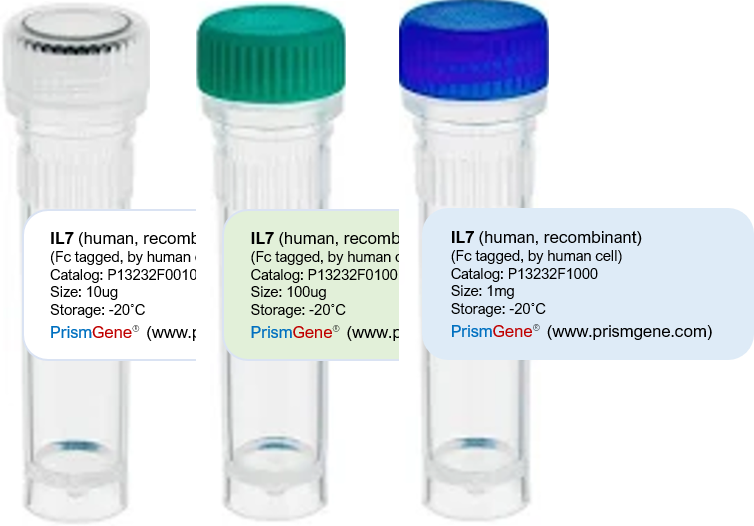
IL7

Price range: $295.00 through $2,495.00
Fusion Tag: C-terminal human Fc
Protein Full Name: Human Interleukin-7
Alternative Names: IL-7
Uniprot ID: P13232
Amino Acids: aa 26-177, plus C-terminal human Fc
Source: Recombinant, expressed in human cell, HEK293
Predicted Molecular Weight (WM): 43.4kDa
SDS-PAGE: 65kDa, reducing condition
Purity: >95%, by SDS-PAGE with Coomassie® Blue Staining.
Endotoxin Level: <1.0 EU/μg of protein.
Activity: Active
Human Interleukin-7 (IL-7) is a secreted, globular cytokine with a molecular weight of approximately 15- 25 kDa depending on its glycosylation state. Structurally, it belongs to the four-alpha-helix bundle family of interleukins. IL-7 is primarily synthesized by non-hematopoietic stromal cells in the bone marrow, thymus, and lymphoid organs. It exerts its biological effects by binding to a heterodimeric cell-surface receptor complex consisting of the IL-7 receptor alpha chain (IL-7Rα / CD127) and the common gamma chain (γc / CD132).
IL-7 is a non-redundant growth factor essential for the adaptive immune system. Upon binding its receptor, it triggers intracellular cascades including the JAK-STAT (principally JAK1/3 and STAT5) and PI3K-Akt pathways. These signals orchestrate several critical functions:
- Lymphocyte Development: It drives the differentiation, maturation, and V(D)J gene rearrangement of T-cell and B-cell progenitors.
- Immune Homeostasis: It acts as a master survival signal by upregulating anti-apoptotic proteins (like Bcl-2) to sustain populations of naïve and memory T cells.
- Proliferation and Function: It enhances the expansion of mature T, B, and natural killer (NK) cells, bolstering global immune response diversity without causing systemic hyper-inflammation.
Due to its capacity to amplify lymphoid populations, recombinant human IL-7 (rhIL-7) serves as a potent immunotherapy:
- Cancer Immunotherapy: IL-7 is used as an adjuvant to accelerate immune reconstitution following bone marrow transplantation or lymphotoxic chemotherapy. It is also employed to enhance the expansion, survival, and antitumor efficacy of CAR-T cell and adoptive cell therapies.
- Lymphopenic and Infectious Diseases: It has been evaluated in clinical trials to safely restore T-cell counts in patients with severe COVID-19, HIV/AIDS, and sepsis, minimizing the incidence of secondary hospital-acquired infections.
- Therapeutic Targets: Conversely, overactivation of the IL-7 axis can fuel autoimmunity (such as multiple sclerosis or rheumatoid arthritis) and drive acute lymphoblastic leukemia, making IL-7/IL-7R antagonists crucial targets for immunosuppressive drug development.
| size | 10ug, 100ug, 1000ug |
|---|
Be the first to review “IL7”
Related products






Reviews
There are no reviews yet.