
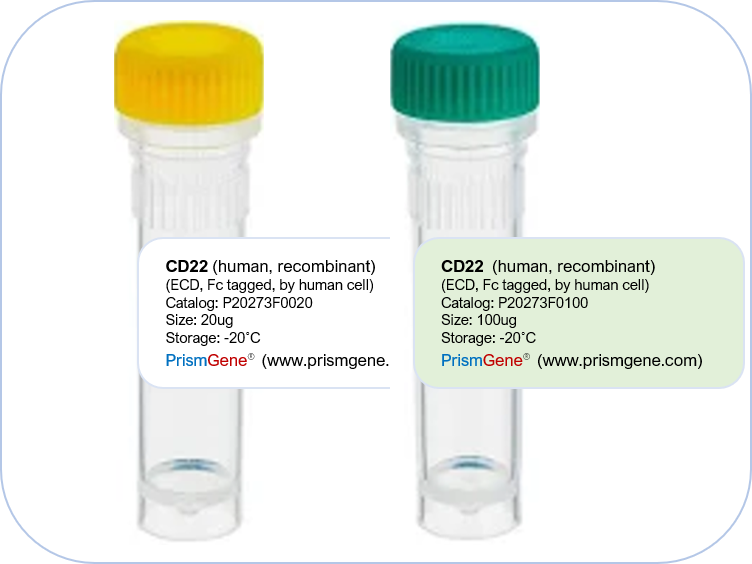
CD22
Price range: $395.00 through $895.00
Fusion Tag: C-terminal human Fc
Protein Full Name: B-cell receptor CD22
Alternative Names: CD22, BL-CAM, B-lymphocyte cell adhesion molecule, Sialic acid-binding Ig-like lectin 2, Siglec-2, T-cell surface antigen Leu-14
Uniprot ID: P20273
Amino Acids: aa 20-687, ECD plus C-terminal human Fc
Source: Recombinant, expressed in human cell, HEK293
Predicted Molecular Weight (WM): 101kDa
SDS-PAGE: kDa, reducing condition
Purity: >95%, by SDS-PAGE with Coomassie® Blue Staining.
Endotoxin Level: <1.0 EU/μg of protein.
Activity: Active
Datasheet (PDF): CD22
CD16a (also known as FcγRIIIa) is a type I transmembrane glycoprotein belonging to the immunoglobulin superfamily. It is encoded by the FCGR3A gene. Structurally, it consists of two extracellular immunoglobulin-like domains that bind to the fragment crystallizable (Fc) region of IgG antibodies, a single-pass transmembrane domain, and a short cytoplasmic tail. Because its cytoplasmic tail lacks intrinsic signaling motifs, CD16a must non-covalently associate with ITAM-bearing adaptor chains (such as CD3ζ or FcεRIγ) to transduce signals inside the cell. CD16a exhibits structural polymorphisms—notably the 158V/F variant—where the presence of valine (V) instead of phenylalanine (F) significantly increases its binding affinity for IgG1.
CD22 (also known as Siglec-2) is a 140 kDa type I transmembrane glycoprotein restricted to the B-cell lineage. It belongs to the sialic acid-binding immunoglobulin-like lectin family. Structurally, it features:
- An extracellular domain with seven immunoglobulin-like domains, featuring an N-terminal V-set domain that specifically binds α2,6-linked sialic acid ligands in both cis and trans configurations.
- A single transmembrane region.
- A cytoplasmic tail containing multiple immunoreceptor tyrosine-based inhibitory motifs (ITIMs).
CD22 serves as a critical co-inhibitory receptor that establishes a signaling threshold to prevent B-cell overactivation and autoimmunity. Upon B-cell receptor (BCR) ligation, tyrosine residues within the cytoplasmic ITIMs are phosphorylated by the Src kinase LYN. This phosphorylation recruits and activates intracellular phosphatases, primarily SHP-1. Activated SHP-1 dephosphorylates key downstream effectors (such as Vav-1, BLNK, and CD19), effectively dampening BCR-induced calcium flux and proliferation signals. Additionally, CD22 undergoes rapid, continuous clathrin-mediated endocytosis, allowing it to internalize surface antigens.
CD22 is expressed on normal mature B cells and highly conserved across the majority of B-cell malignancies, it is a premier therapeutic target such as antibody-drug conjugates (ADCs), immunotoxins, CAR-T cell therapy, monoclonal antibodies.
Inotuzumab-ozogamicin were approved for relapsed/refractory B-cell acute lymphoblastic leukemia (B-ALL); leverages CD22’s rapid endocytosis to deliver cytotoxic cargo directly into malignant cells.
Moxetumomab-pasudotox is targeted therapy optimized for treating hairy cell leukemia.
CD22-directed or dual-targeting (CD19/CD22) CAR-Y for combating antigen escape and relapse observed in CD19-alone therapies, often demonstrating reduced neurotoxicity.
Epratuzumab was evaluated in autoimmune conditions like Systemic Lupus Erythematosus (SLE) to modulate pathogenic B-cell thresholds.
References:
- Nature 428:529-535 (2004)
- Science 269:242-244 (1995)
- Biol. Chem. 297:0-0 (2021)
| Size | 20ug, 100ug |
|---|
Be the first to review “CD22”
Related products
Reviews
There are no reviews yet.