
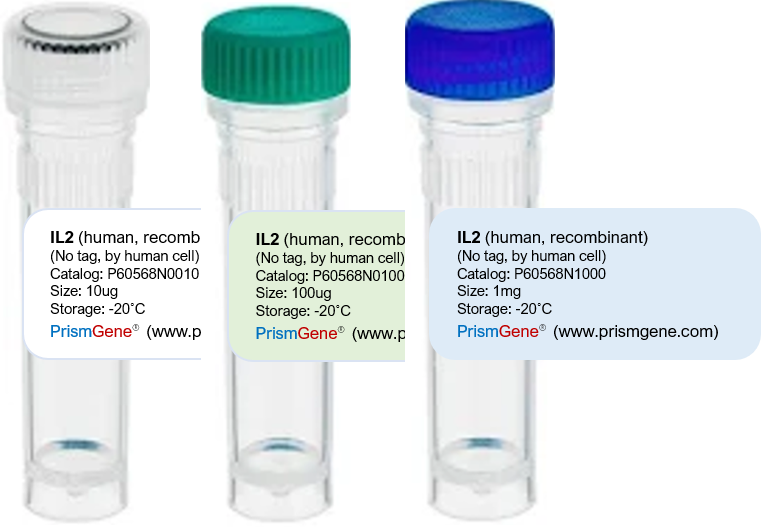
IL-2, Tag-free

Price range: $200.00 through $1,200.00
Protein Full Name: Interleukin-2
Alternative Names: IL2. TCGF, T-cell growth factor, INN: Aldesleukin.
Gene Synonyms: IL2
Uniprot ID: P60568
Fusion Tag: Tag-free
Amino Acids: aa21-153
Source: Recombinant, expressed in human cell, HEK293
Predicted Molecular Weight (WM): 15.4kDa
SDS-PAGE: 18kDa, reducing condition
Purity: >95%, by SDS-PAGE with Coomassie® Blue Staining.
Endotoxin Level: <1.0 EU/μg of protein.
Activity: Active
Interleukin-2 (IL-2) is a cytokine signaling molecule in the immune system produced by activated CD4+ and CD8+ T-cells in response to antigenic or mitogenic stimulation. IL-2 is part of the body’s natural response to microbial infection, and in discriminating between foreign (“non-self”) and “self”. It regulates the activities of white blood cells (leukocytes, also lymphocytes) that are responsible for immunity and mediates its effects by binding to IL-2 receptors, which are expressed by lymphocytes. IL-2 is a member of a cytokine family, each member of which has a four alpha helix bundle; the family also includes IL-4, IL-7, IL-9, IL-15, and IL-21. IL-2 signals through the IL-2 receptor (IL2R), a complex consisting of three chains, termed alpha (CD25), beta (CD122) and gamma (CD132). The gamma chain is shared by all family members.
The IL-2 receptor (IL-2R) α subunit (CD25) binds IL-2 with low affinity (Kd~10−8M). Interaction of IL-2 and CD25 alone does not lead to signal transduction due to its short intracellular chain but has the ability (when bound to the β and γ subunit) to increase the IL-2R affinity 100-fold. Heterodimerization of βγ subunits of IL-2R is essential for signalling in T cells. IL-2 can signalize either via intermediate-affinity dimeric CD122/CD132 IL-2R (Kd~10−9M) or high-affinity trimeric CD25/CD122/CD132 IL-2R (Kd~10−11M). Dimeric IL-2R is expressed by memory CD8+ T cells and NK cells, whereas trimeric IL-2R is highly expressed by regulatory T cells and activated T cells.
IL-2 has essential roles in key functions of the immune system, tolerance, and immunity, primarily via its direct effects on T cells. In the thymus, where T cells mature, it prevents autoimmune diseases by promoting the differentiation of certain immature T cells into regulatory T cells, which suppress other T cells that are otherwise primed to attack normal healthy cells in the body. IL-2 enhances activation-induced cell death (AICD). It also promotes the differentiation of T cells into effector T cells and into memory T cells when the initial T cell is also stimulated by an antigen, helping the body fight off infections. IL-2 with other polarizing cytokines stimulates naive CD4+ T cell differentiation into Th1 and Th2 lymphocytes and impedes differentiation into Th17 and follicular Th lymphocytes.
IL-2 increases the cell killing activity of both natural killer cells and cytotoxic T cells. Its expression and secretion are tightly regulated and functions as part of both transient positive and negative feedback loops in mounting and dampening immune responses. Through its role in the development of T cell immunologic memory, which depends upon the expansion of the number and function of antigen-selected T cell clones, it plays a key role in enduring cell-mediated immunity.
| Weight | 0.5 lbs |
|---|---|
| Dimensions | 12 × 8 × 0.2 in |
| Size | 20ug, 100ug, 1mg |
Be the first to review “IL-2, Tag-free”
Related products






Reviews
There are no reviews yet.