
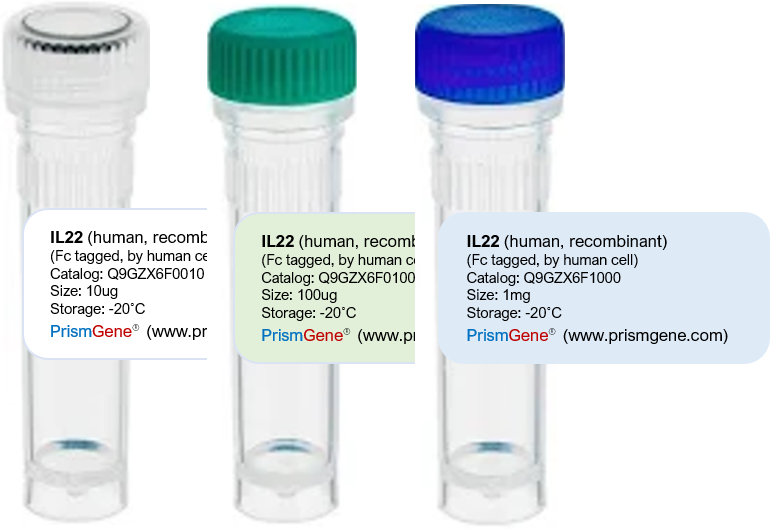
IL22


Price range: $295.00 through $2,495.00
Fusion Tag: C-terminal human Fc
Protein Full Name: Human Interleukin-22
Alternative Names: IL-22, IL-TIF, Cytokine Zcyto18, IL-10-related T-cell-derived-inducible factor
Uniprot ID: Q9GZX6
Amino Acids: aa 34-179, plus C-terminal human Fc
Source: Recombinant, expressed in human cell, HEK293
Predicted Molecular Weight (WM): 42.7kDa
SDS-PAGE: 65kDa, reducing condition
Purity: >95%, by SDS-PAGE with Coomassie® Blue Staining.
Endotoxin Level: <1.0 EU/μg of protein.
Human interleukin-22 (IL-22) is a 146-amino-acid alpha-helical cytokine belonging to the IL-10 family. It features a compact globular fold stabilized by two critical disulfide bonds, displaying a characteristic four-helix bundle core. Structurally, IL-22 acts as an independent monomer that forms a functional ternary complex by sequentially binding to a heterodimeric surface receptor consisting of IL-22R1 and IL-10R2 chains. A soluble decoy receptor known as IL-22 binding protein (IL-22BP) can competitively bind IL-22 to neutralize its activity and regulate systemic responses.
Unlike most interleukins, IL-22 does not facilitate communication between hematopoietic immune cells. Instead, its biological activity is targeted toward non-hematopoietic epithelial cells and fibroblasts in the skin, liver, pancreas, and gastrointestinal and respiratory tracts.
Upon binding its receptor complex, IL-22 primarily activates the JAK1/Tyk2 and STAT3 signaling pathways, alongside MAPK and PI3K-Akt-mTOR pathways. This signaling cascade triggers:
- Barrier Defense: The upregulation of antimicrobial peptides (e.g., defensins, S100 proteins, REG3α/β) and mucins.
- Tissue Repair: The stimulation of epithelial cell proliferation, anti-apoptotic pathways, and tissue regeneration.
IL-22 serves as a “double-edged sword” with dual tissue-protective and pro-inflammatory pathologies.
- Therapeutic Agonism: Recombinant human IL-22 fusion proteins (such as F-652 and UTTR1147A) are utilized to exploit its regenerative properties. Clinical focus targets Inflammatory Bowel Disease (IBD), acute liver injury/NASH, and graft-versus-host disease (GVHD) by promoting mucosal healing and organ protection.
- Therapeutic Antagonism: Conversely, because overproduction of endogenous IL-22 drives abnormal keratinocyte hyperplasia, neutralizing IL-22 or blocking its cascade is a strategic target for treating chronic inflammatory skin disorders like psoriasis and atopic dermatitis.
| size | 10ug, 100ug, 1000ug |
|---|
Be the first to review “IL22”
Related products






Reviews
There are no reviews yet.