
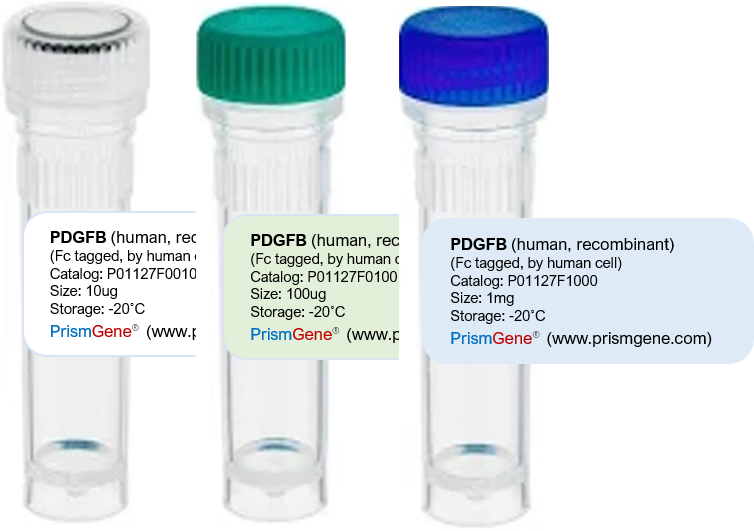
PDGFB


Price range: $295.00 through $2,495.00
Fusion Tag: C-terminal human Fc
Protein Full Name: Human Platelet-derived growth factor subunit B
Alternative Names: PDGF-B, PDGFB, PDGF2, SIS
Uniprot ID: P01127
Amino Acids: aa 82-190, plus C-terminal human Fc
Source: Recombinant, expressed in human cell, HEK293
Predicted Molecular Weight (WM): 38.3 kDa
SDS-PAGE: 55kDa, reducing condition
Purity: >95%, by SDS-PAGE with Coomassie® Blue Staining.
Endotoxin Level: <1.0 EU/μg of protein.
Activity: Active
Platelet-Derived Growth Factor Subunit B (PDGFB) is a critical protein encoded by the PDGFB gene on chromosome 22q13.1. It plays a foundational role in cell signaling, tissue regeneration, and vascular development.
PDGFB is synthesized as a 241-amino acid precursor molecule (preproprotein) that includes both amino- and carboxy-terminal propeptides. Before becoming fully operational, this precursor must undergo proteolytic processing where it is cleaved by endopeptidases. The processed proteins then pair up via disulfide bonds to form a functional dimer. It can either form a homodimer (PDGF-BB) or pair with the PDGF A-chain to create a heterodimer (PDGF-AB).
PDGFB acts as a potent mitogen (a chemical substance that encourages cell division) primarily targeting cells of mesenchymal origin, such as fibroblasts and smooth muscle cells. When PDGF-BB binds to its cell-surface receptor tyrosine kinase PDGFR-ß, it triggers intracellular cascades like the PI3K/Akt and Ras/MAPK pathways. These pathways orchestrate:
- Cellular growth and multiplication (proliferation).
- Cell migration and directional movement.
- Angiogenesis, specifically the recruitment of pericytes and vascular smooth muscle cells needed to stabilize new blood vessels.
PDGFB has profound implications in therapeutics and diagnostics:
- Wound Healing: Recombinant human PDGF-BB (becaplermin, marketed as Regranex) is an FDA-approved topical gel widely utilized to accelerate the healing of chronic diabetic foot ulcers by promoting tissue repair and collagen deposition.
- Oncology & Diagnostics: A specific genetic translocation, t(17;22), fuses the PDGFB gene with the COL1A1 gene. This produces an uncontrolled autocrine loop driving Dermatofibrosarcoma Protuberans (DFSP), a rare skin tumor. Doctors use Fluorescence In Situ Hybridization (FISH) to detect this PDGFB rearrangement to confirm DFSP diagnoses. Furthermore, this fusion makes the tumor highly sensitive to targeted therapy with the tyrosine kinase inhibitor imatinib.
- Rare Diseases: Loss-of-function mutations in PDGFB disrupt the blood-brain barrier and lead to idiopathic basal ganglia calcification (Fahr’s disease).
| size | 10ug, 100ug, 1000ug |
|---|
Be the first to review “PDGFB”
Related products




Reviews
There are no reviews yet.