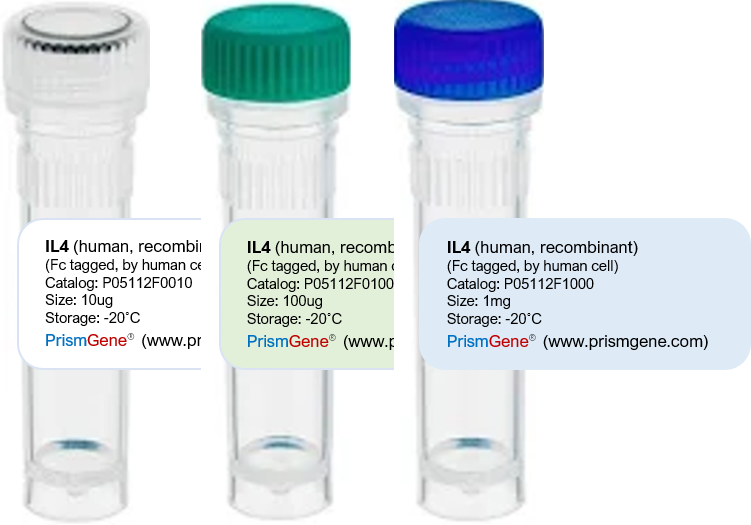
IL4


Price range: $295.00 through $2,495.00
Fusion Tag: C-terminal human Fc
Protein Full Name: Human interleukin-4
Alternative Names: IL-4, BSF-1, B-cell stimulatory factor 1, Lymphocyte stimulatory factor 1, Binetrakin, Pitrakinra
Uniprot ID: P05112
Amino Acids: aa 25-153, plus C-terminal human Fc
Source: Recombinant, expressed in human cell, HEK293
Predicted Molecular Weight (WM): 43.4kDa
SDS-PAGE: 50kDa, reducing condition
Purity: >95%, by SDS-PAGE with Coomassie® Blue Staining.
Endotoxin Level: <1.0 EU/μg of protein.
Activity: Active
Human interleukin-4 (IL-4) is a glycosylated, single-chain protein belonging to the four α-helix bundle cytokine family. Structurally, it features a compact, globular fold composed of four anti-parallel α-helices arranged with a left-handed twist. Its structural stability and spatial configuration are maintained by three intra-chain disulfide bonds.
IL-4 serves as a pleiotropic, prototypic immunoregulatory cytokine primarily secreted by activated Th2 cells, mast cells, basophils, and eosinophils. It functions by binding to two receptor complexes: Type I: Expressed on hematopoietic cells, consisting of the IL-4Rα subunit and the common gamma chain γ. Type II: Expressed on non-hematopoietic cells, consisting of IL-4Rα and IL-13Rα.
Upon binding, it triggers downstream JAK-STAT signaling, primarily activating STAT6. Its primary physiological roles include driving the differentiation of naive CD4+ T cells into Th2 cells, promoting B-cell immunoglobulin class switching to IgE and IgG4, upregulating MHC Class II expression, and polarizing macrophages toward an anti-inflammatory M2 phenotype to support tissue repair.
Because overproduction of IL-4 drives type 2 mediated inflammation, its pathway is a key drug target:
- Monoclonal Antibodies: The primary clinical application is dupilumab, a therapeutic antibody targeting the IL-4Rα subunit. By blocking both IL-4 and IL-13 signaling, it is FDA-approved to treat severe atopic conditions like atopic dermatitis, moderate-to-severe asthma, and chronic rhinosinusitis with nasal polyposis.
- Oncology: IL-4 is being investigated in clinical trials for solid tumors (such as non-small cell lung cancer), where blocking the IL-4 pathway may reverse tumor-associated immunosuppression and enhance anti-cancer immunity.
| size | 10ug, 100ug, 1000ug |
|---|
Be the first to review “IL4”
Related products






Reviews
There are no reviews yet.