
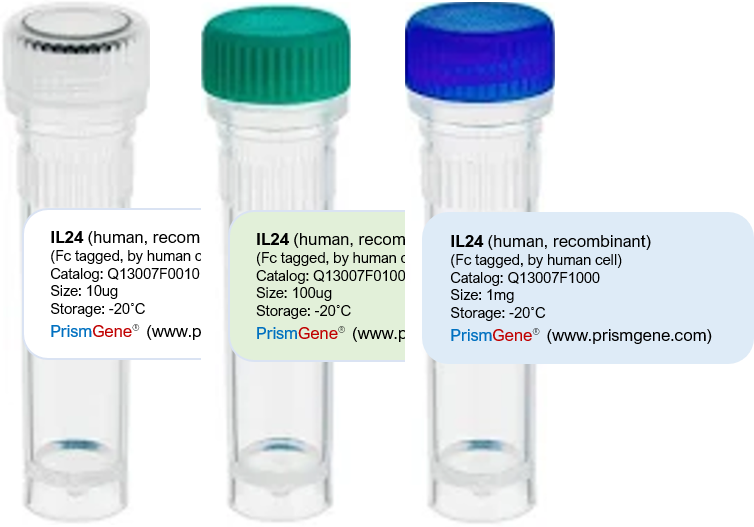
IL24

Price range: $295.00 through $2,495.00
Fusion Tag: C-terminal human Fc
Protein Full Name: Human Interleukin-24
Alternative Names: IL-24, MDA-7, Melanoma differentiation-associated gene 7 protein, Suppression of tumorigenicity 16 protein
Uniprot ID: Q13007
Amino Acids: aa 52-206, plus C-terminal human Fc
Source: Recombinant, expressed in human cell, HEK293
Predicted Molecular Weight (WM): 44.1kDa
SDS-PAGE: 63kDa, reducing condition
Purity: >95%, by SDS-PAGE with Coomassie® Blue Staining.
Endotoxin Level: <1.0 EU/μg of protein.
Activity: Active
Human interleukin-24 (IL-24), originally identified as melanoma differentiation-associated gene 7 (mda-7), is a member of the IL-10 cytokine family. The human IL24 gene is located on chromosome 1q32-33. It encodes a 206-amino acid precursor protein with a molecular weight of approximately 24 kDa. The mature, secreted protein ranges from 18-35 kDa due to extensive N-linked glycosylation, which is crucial for its stability, solubility, and bioavailability. Structurally, it contains an IL-10 signature motif and lacks several traditional disulfide bonds found in other cytokines, which contributes to its unique surface properties and relative instability.
IL-24 is a pleiotropic cytokine secreted by both immune cells (such as monocytes, macrophages, and Th2 cells) and non-immune cells (like keratinocytes and epithelial cells). It exerts its biological functions through canonical and non-canonical signaling pathways:
- Canonical Signaling: IL-24 binds to two heterodimeric cell surface receptor complexes: IL-20R1/IL-20R2 and IL-22R1/IL-20R2. This binding triggers the JAK/STAT (specifically STAT1 and STAT3) and MAPK pathways to regulate tissue homeostasis, epidermal functions, and immune cell infiltration.
- Non-Canonical Signaling: Intracellularly, IL-24 interacts with endoplasmic reticulum chaperones like the Sigma 1 Receptor, leading to ER stress, reactive oxygen species (ROS) production, and calcium mobilization. Crucially, this mechanism induces apoptosis and autophagy selectively in cancer cells without harming healthy tissue.
IL-24 holds major clinical potential, primarily as a targeted cancer therapeutic. Due to its unique ability to destroy tumor cells while sparing normal ones, clinical trials have utilized adenoviral vectors (Ad.IL-24/INGN-241) and recombinant proteins to treat melanomas, carcinomas, and solid tumors. It also works synergistically with radiation and chemotherapies by suppressing tumor angiogenesis, metastasis, and invasion. Conversely, because elevated IL-24 drives pathogenic inflammation in autoimmune and allergic conditions, such as psoriasis, rheumatoid arthritis, and atopic dermatitis, IL-24 antagonists or JAK inhibitors are being actively explored as targeted anti-inflammatory treatments.
| size | 10ug, 100ug, 1000ug |
|---|
Be the first to review “IL24”
Related products





Reviews
There are no reviews yet.