
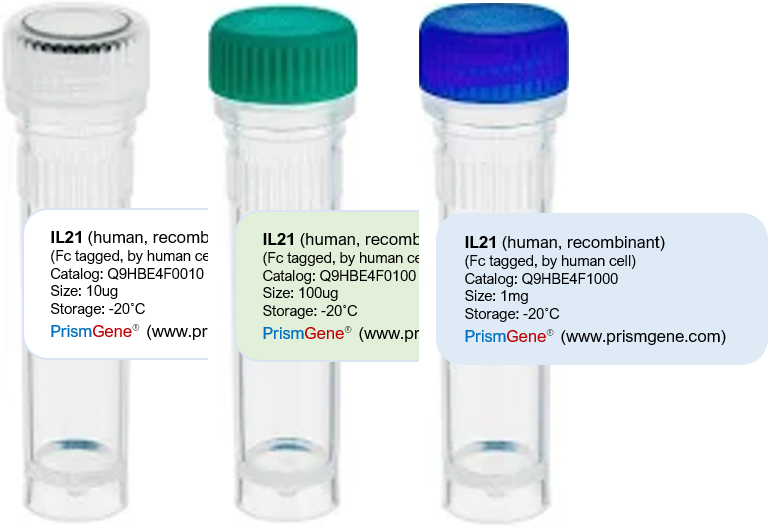
IL21

Price range: $295.00 through $2,495.00
Fusion Tag: C-terminal human Fc
Protein Full Name: Human Interleukin-21
Alternative Names: IL-21, Za11
Uniprot ID: Q9HBE4
Amino Acids: aa 25-162, plus C-terminal human Fc
Source: Recombinant, expressed in human cell, HEK293
Predicted Molecular Weight (WM): 43.5kDa
SDS-PAGE: 50kDa, reducing condition
Endotoxin Level: <1.0 EU/μg of protein.
Activity: Active
Human IL-21 is a member of the common gamma-chain (γc) of cytokines, which also includes IL-2, IL-4, IL-7, IL-9, and IL-15. Structurally, it is characterized by a four α-helix bundle configuration. It initiates downstream signaling by binding to a heterodimeric receptor complex consisting of its unique high-affinity IL-21 receptor α chain (IL-21Rα and the shared common γc subunit (CD132).
Mainly secreted by activated CD4+ T helper cells (especially Th17 and T follicular helper Tfh cells) and Natural Killer T (NKT) cells, IL-21 signals predominantly through the JAK/STAT (specifically JAK1/3 and STAT3) pathway. Its major immunological functions include:
- Adaptive Immunity: Promoting the differentiation of Tfh and Th17 cells, while expanding CD8+ T cells and preventing their exhaustion during chronic infections.
- Humoral Immunity: Driving B cell proliferation, germinal center formation, and differentiation into antibody-secreting plasma cells.
- Innate Immunity: Enhancing the maturation, proliferation, and cytotoxic activity of Natural Killer (NK) cells.
Unlike IL-2, IL-21 uniquely does not stimulate regulatory T cells (Tregs), avoiding their suppressive feedback loops.
Clinical manipulation of IL-21 targeting involves two opposite approaches:
- Oncology (Agonists): Recombinant human IL-21 (rIL-21) has been evaluated in phase I/II clinical trials for metastatic melanoma and renal cell carcinoma. Additionally, it is used ex vivo to expand highly cytotoxic CAR-T cells and NK cells for adoptive cell therapies.
- Autoimmunity (Antagonists): Because excessive IL-21 production drives pathological autoantibody creation, anti-IL-21 monoclonal antibodies or IL-21R-Fc decoy inhibitors are being investigated to treat chronic inflammatory diseases like rheumatoid arthritis, systemic lupus erythematosus (SLE), and Crohn’s disease.
| size | 10ug, 100ug, 1000ug |
|---|
Be the first to review “IL21”
Related products




Reviews
There are no reviews yet.