
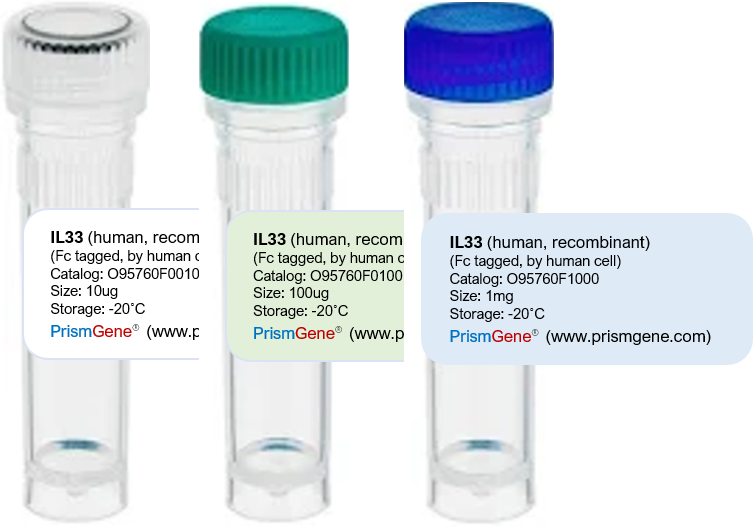
IL33


Price range: $295.00 through $2,495.00
Fusion Tag: C-terminal human Fc
Protein Full Name: Interleukin-33
Alternative Names: IL-33, IL-1F11, Interleukin-1 family member 11, Nuclear factor from high endothelial venules+F123, NF-HEV, Cleaved into the following 3 chains: Interleukin-33 (95-270), Interleukin-33 (109-270) Interleukin-33 (99-270)
Uniprot ID: O95760
Amino Acids: aa 95-270, plus C-terminal human Fc
Source: Recombinant, expressed in human cell, HEK293
Predicted Molecular Weight (WM): 46kDa
SDS-PAGE: 65kDa, reducing condition
Purity: >95%, by SDS-PAGE with Coomassie® Blue Staining.
Endotoxin Level: <1.0 EU/μg of protein.
Activity: Active
Interleukin-33 (IL-33) is a dual-function protein belonging to the IL-1 superfamily that plays a pivotal role in tissue homeostasis, innate immunity, and inflammatory diseases.
IL-33 is synthesized as a 30 kDa full-length precursor protein (approx. 270 amino acids). Structurally, it consists of three main domains:
- An N-terminal nuclear localization domain containing a helix-turn-helix (HTH) motif that allows it to bind to chromatin inside the nucleus.
- A central protease-sensing domain vulnerable to cleavage.
- A C-terminal IL-1-like cytokine domain featuring a beta-trefoil structure required for extracellular receptor binding.
Unlike traditional cytokines, it lacks an N-terminal signal peptide for classical secretion.
IL-33 operates through two distinct biological modalities:
- Intracellular Transcriptional Regulator: Inside healthy epithelial, endothelial, and fibroblastic cells, full-length IL-33 localizes to the nucleus, binding heterochromatin to function as a transcriptional repressor.
- Extracellular Alarmin: Upon cellular necrosis or mechanical stress, IL-33 is passively released into the extracellular space as an “alarmin” to alert the immune system. It binds a heterodimeric receptor complex consisting of ST2 (IL-1RL1) and IL-1RAcP on target immune cells. This activates MyD88-dependent signaling pathways, robustly driving Type 2 innate and adaptive immunity by stimulating group 2 innate lymphoid cells (ILC2s), mast cells, and Th2 cells to secrete pro-inflammatory cytokines like IL-5 and IL-13.
Because the IL-33/ST2 axis is a primary driver of airway hyperresponsiveness and mucosal inflammation, it is a major therapeutic target. Monoclonal antibodies like tozorakimab, itepekimab, and astegolimab are utilized in clinical developments to treat severe asthma, COPD, and atopic dermatitis by blocking IL-33 from binding to ST2.
The soluble decoy form of its receptor, sST2, is actively used as a clinical prognostic biomarker for heart failure and cardiac hypertrophy, where elevated serum levels strongly correlate with myocardial strain and adverse cardiovascular outcomes.
| size | 10ug, 100ug, 1000ug |
|---|
Be the first to review “IL33”
Related products




Reviews
There are no reviews yet.