
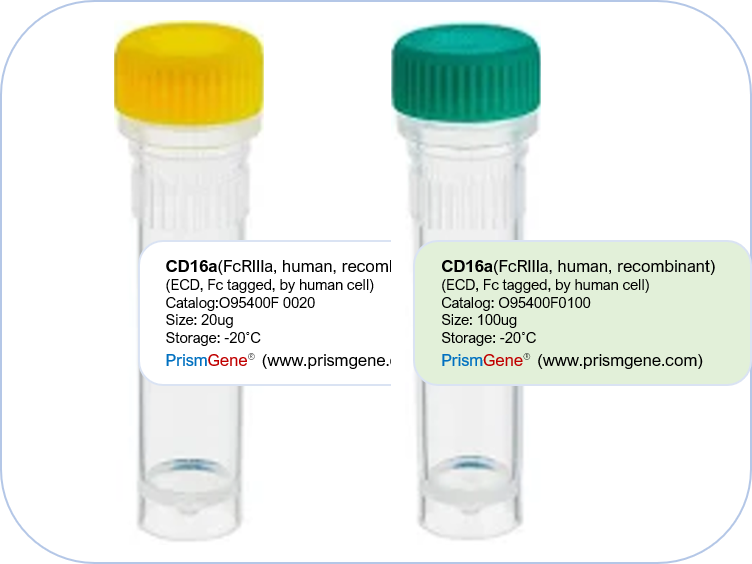
CD16a (FcRIIIa)
Fusion Tag: C-terminal human Fc
Protein Full Name: CD16a antigen
Alternative Names: CD16a(FcRIIIa), Fc-gamma RIII-alpha, Fc-gamma RIIIa, Fc-gamma RIII, FcRIII, FcRIIIa, FcR-10, IgG Fc receptor III-2, Low affinity immunoglobulin gamma Fc region receptor III-A
Uniprot ID: O95400
Amino Acids: aa 17-208, ECD plus C-terminal human Fc
Source: Recombinant, expressed in human cell, HEK293
Predicted Molecular Weight (WM): 48kDa
SDS-PAGE: 50kDa, reducing condition
Purity: >95%, by SDS-PAGE with Coomassie® Blue Staining.
Endotoxin Level: <1.0 EU/μg of protein.
Activity: Active
Datasheet (PDF): CD16a (FcRIIIa)
CD16a (also known as FcγRIIIa) is a type I transmembrane glycoprotein belonging to the immunoglobulin superfamily. It is encoded by the FCGR3A gene. Structurally, it consists of two extracellular immunoglobulin-like domains that bind to the fragment crystallizable (Fc) region of IgG antibodies, a single-pass transmembrane domain, and a short cytoplasmic tail. Because its cytoplasmic tail lacks intrinsic signaling motifs, CD16a must non-covalently associate with ITAM-bearing adaptor chains (such as CD3ζ or FcεRIγ) to transduce signals inside the cell. CD16a exhibits structural polymorphisms—notably the 158V/F variant—where the presence of valine (V) instead of phenylalanine (F) significantly increases its binding affinity for IgG1.
CD16a is primarily expressed on natural killer (NK) cells and monocytes/macrophages. Its foundational role is bridging the innate and adaptive immune systems.
- Antibody-Dependent Cellular Cytotoxicity (ADCC): When antibodies coat a target pathogen or tumor cell, CD16a binds their Fc regions. This cross-linking activates NK cells to degranulate and release perforin and granzymes, inducing apoptosis in the target cell.
- Phagocytosis and Cytokine Production: In macrophages, CD16a engagement triggers antibody-dependent cellular phagocytosis (ADCP) and stimulates the secretion of pro-inflammatory cytokines like IFN-γ and TNF-α.
- Regulation: Upon activation, the receptor undergoes rapid down-regulation via ectodomain shedding mediated by the metalloproteinase ADAM17, which acts as a temporal brake on immune activation.
CD16a is a cornerstone of modern cancer immunotherapy and target-directed therapeutics.
The efficacy of blockbuster anti-tumor mAbs like rituximab and trastuzumab relies heavily on their ability to engage CD16a to drive ADCC. Engineering efforts actively focus on altering mAb glycan structures (e.g., afucosylation) to increase CD16a binding affinity.
Novel multi-specific scaffolds—such as Bispecific Killer Cell Engagers (BiKEs) and tetravalent engagers (e.g., AFM24)—bypass normal antibody limits by directly tethering CD16a on NK cells to tumor-associated antigens.
Overactivation of CD16a drives tissue destruction in autoimmune diseases like rheumatoid arthritis and systemic lupus erythematosus. In these contexts, CD16a antagonists are clinically explored to block Fc-mediated damage.
References:
- Cell 127:635-648 (2006)
- PNAS 105:10762-10767 (2008)
- Struct. Mol. Biol. 24:325-336 (2017)
Be the first to review “CD16a (FcRIIIa)”
Related products

Reviews
There are no reviews yet.