
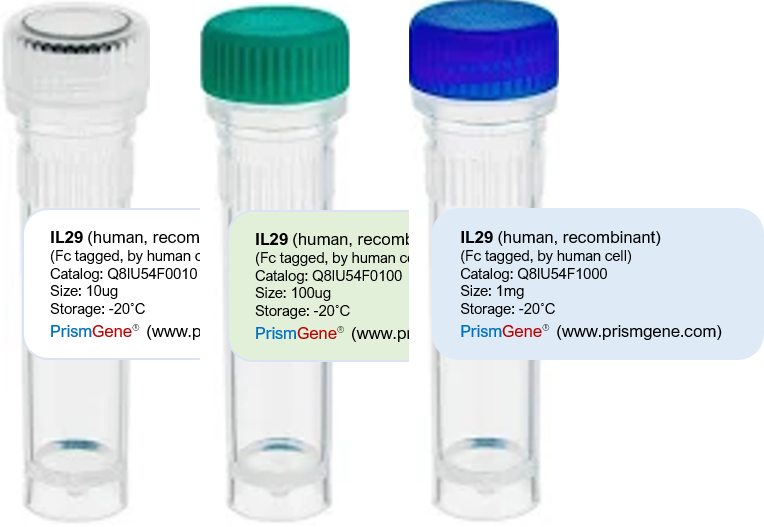
IL29


Price range: $295.00 through $2,495.00
Fusion Tag: C-terminal human Fc
Protein Full Name: Human Interleukin-29
Alternative Names: IL-29, IFNL1, Interferon lambda-1, IFN-lambda-1, Cytokine Zcyto21
Uniprot ID: Q8IU54
Amino Acids: aa 20-200, plus C-terminal human Fc
Source: Recombinant, expressed in human cell, HEK293
Predicted Molecular Weight (WM): 46kDa
SDS-PAGE: 65kDa, reducing condition
Purity: >95%, by SDS-PAGE with Coomassie® Blue Staining.
Endotoxin Level: <1.0 EU/μg of protein.
Activity: Active
Human interleukin-29 (IL-29), also designated as Interferon lambda-1 (IFN-λ1), is a crucial cytokine that bridges the gap between innate and adaptive immunity. It plays a pivotal role in mucosal defense, antiviral protection, and immunoregulation.
IL-29 is a member of the helical cytokine family and belongs to the type III interferon subfamily. Encoded by the IL29 gene on human chromosome 19, the mature protein is a monomer composed of approximately 181 amino acids with a molecular mass of roughly 20 kDa. Structurally, IL-29 is distantly related to the IL-10 family. However, its primary amino acid sequence shares notable similarities with type I interferons (such as IFN-α and IFN-β), allowing it to evoke similar cellular responses.
IL-29 exerts its effects by binding to a specific heterodimeric receptor complex consisting of IFNLR1 (IL-28Rα) and IL10RB. Unlike type I interferon receptors which are ubiquitously expressed, IL-29 receptors are highly restricted, primarily found on epithelial cells, hepatocytes, and keratinocytes.
Upon binding, it triggers the JAK-STAT signaling pathway (primarily activating STAT1 and STAT2). This cascade upregulates interferon-stimulated genes (ISGs) to establish an antiviral state, enhances MHC class I antigen presentation, and modulates the secretion of pro-inflammatory cytokines.
Due to its restricted receptor profile, IL-29 serves as a promising therapeutic alternative to type I interferons for treating chronic viral infections like Hepatitis B and C or respiratory pathogens. It offers localized antiviral efficacy with significantly fewer systemic adverse side effects (like myelosuppression and depression).
IL-29 exhibits anti-tumor properties by inhibiting tumor cell proliferation, inducing apoptosis, and functioning as an antiangiogenic factor to restrict blood vessel growth in various malignancies.
Elevated or dysregulated serum levels of IL-29 serve as valuable diagnostic or prognostic biomarkers for coronary heart disease, obesity-induced insulin resistance, and autoimmune conditions such as rheumatoid arthritis and psoriasis. Targeting or neutralizing IL-29 signaling pathways offers a novel therapeutic window for controlling chronic inflammatory diseases.
| size | 10ug, 100ug, 1000ug |
|---|
Be the first to review “IL29”
Related products






Reviews
There are no reviews yet.