
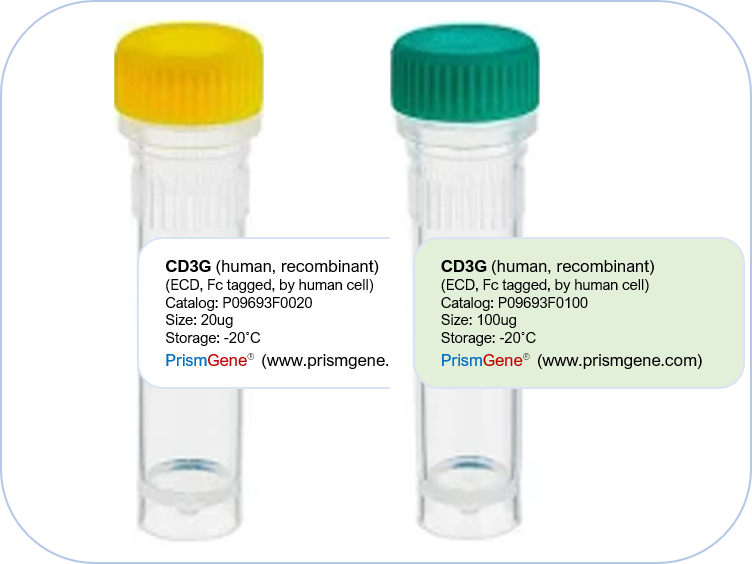
CD3G
Price range: $395.00 through $895.00
Fusion Tag:C-terminal human Fc
Protein Full Name: T-cell surface glycoprotein CD3 gamma chain
Alternative Names: T-cell receptor T3 gamma chain
Uniprot ID: P09693
Amino Acids: aa 23-116, ECD plus C-terminal human Fc
Source: Recombinant, expressed in human cell, HEK293
Predicted Molecular Weight (WM): 36.7kDa
SDS-PAGE: 50kDa, reducing condition
Purity: >95%, by SDS-PAGE with Coomassie® Blue Staining.
Endotoxin Level: <1.0 EU/μg of protein.
Datasheet: CD3G
CD3g encodes the CD3-gamma (CD3γ) subunit, a type I transmembrane glycoprotein belonging to the immunoglobulin superfamily. The protein comprises an extracellular Ig-like domain that non-covalently pairs with CD3-epsilon (CD3ε) to form a heterodimer. This heterodimer joins CD3δε, CD3ζζ, and the clonotypic T-cell receptor (TCR) αβ or γδ chains to assemble the full multisubunit TCR-CD3 complex. Intracellularly, CD3γ possesses a short cytoplasmic tail harboring a single immunoreceptor tyrosine-based activation motif (ITAM) and a specialized di-leucine-based sorting motif.
CD3γ is essential for adaptive immunity, executing two primary biochemical roles:
- Signal Transduction: While the TCR heterodimer binds antigens, it cannot signal independently due to its short cytoplasmic tail. Upon antigen recognition, Src family kinases (LCK and FYN) phosphorylate the ITAM on CD3γ. This cascades intracellular activations, recruiting ZAP-70 to drive T-cell proliferation, differentiation, and survival.
- Receptor Trafficking: The di-leucine motif regulates constitutive TCR cycling and internalization. This continuous recycling preserves cell-surface receptor quality and maintains signaling competence. It also plays an accessory role in early thymic selection and T-cell development.
Biallelic mutations in CD3G lead to CD3γ deficiency, an ultra-rare primary immunodeficiency. Unlike complete deficiencies of CD3ε or CD3δ, which cause fatal, severe combined immunodeficiency (SCID) lacking T cells entirely, CD3γ mutations produce a milder, delayed-onset combined immunodeficiency with residual T cells.
Patients often present with immune dysregulation, characterized by severe autoimmune cytopenias, inflammatory bowel disease (colitis), and vitiligo due to defective negative selection in the thymus.
Clinically, CD3 serves as a standard immunohistochemical marker to diagnose T-cell lymphomas. Furthermore, down-regulated CD3G acts as a diagnostic biomarker for depression, while altered expression profiles in various malignancies correlate with immune cell infiltration, serving as a survival prognosticator.
References:
- Cell 93:1021-1029 (1998)
- Immunity 58:1646-1659.e5 (2025)
- Nature 634:729-736 (2024)
| Size | 20ug, 100ug |
|---|
Be the first to review “CD3G”
Related products

Reviews
There are no reviews yet.